Saudi Arabia is setting clear national goals for transport efficiency. The Saudi Corporate Average Fuel Economy (CAFE) standard targets an average of 16.0 km/L (6.25 L/100km) for new vehicles in 2025 (SASO 2024). This choice at the dealership (selecting a modern, efficient powertrain) is a critical first step. But our research shows this is only a part of the battle to reduce transport emissions. After you've bought a brand new, 2025-compliant car, a second set of decisions takes over: your daily operational habits.
These habits can easily erase 15-30% of the technological gains you paid for at highway speeds and 10-40% in stop-and-go traffic , turning your efficient new car into a drain on your wallet and the environment. We built a model to quantify the extra cost of three common driving habits, based on the national average of 29,500km driven annually:
-
The “Aggressive Driving” Penalty: This is the most significant factor. “Aggressive driving”, defined as rapid acceleration, speeding, and hard braking, uses more energy. Research from the U.S. Department of Energy (DOE) confirms this habit alone can lower fuel economy by 15-40% (US DOE and US EPA 2017)1. For our model, we applied a conservative 20% penalty to account for consistent aggressive behavior in mixed city and highway driving.
-
The "Tire Pressure" Penalty: This is a simple maintenance choice. Driving on under-inflated tires increases rolling resistance, forcing the engine to work harder, consuming 2-3% more fuel (Thomas, Huff, and West 2014) . We factored in a 3% penalty, corresponding to tires that are underinflated by roughly 75%.
-
The "A/C Hack" Penalty: In our climate, A/C is essential. But how you use it matters. A/C use in extreme heat can reduce fuel economy by over 25% in conventional vehicles (most notably on short trips) and has a greater impact on electric vehicles . In Saudi Arabia's heat, using the “Fresh Air” mode makes your A/C work harder because it constantly cools the 40°C outdoor air. Instead, using the "recirculation" button for part of the time (around 50-70%), allows the system to re-cool the air already inside the car, which is much easier. This can save around 5-10% in fuel use (Jung et al. 2017) . In our analysis, we assumed a 10% fuel penalty when drivers cool outside air instead of using the "recirculation" button.
What does this mean for your wallet? Our model (visualized in the Figure 1 below) compared three drivers, all starting with the same 2025 CAFE-compliant car (16.0 km/L) and driving the national average of 29,500 km/year.
-
The Efficient Driver (Baseline): This driver is smooth, checks their tires, and frequently uses A/C recirculation. Their annual fuel cost is ~4,020 SAR.
-
The Average Driver (16.5% Penalty): This driver is in a hurry, with some aggressive habits. Their habits add an extra cost of ~663 SAR per year.
-
The Inefficient Driver (33% Penalty): This driver consistently drives aggressively, neglects tires, and misuses the A/C. These habits add an extra cost of 1,326 SAR per year.
As the data shows (Figure 1), these decisions are not just about money. The inefficient driver is also dumping an extra 1,400 kg of CO2 into the atmosphere annually - a weight comparable to a small sedan. Therefore, the most powerful technology for saving fuel is not just in the powertrain; it's in your driving habits.
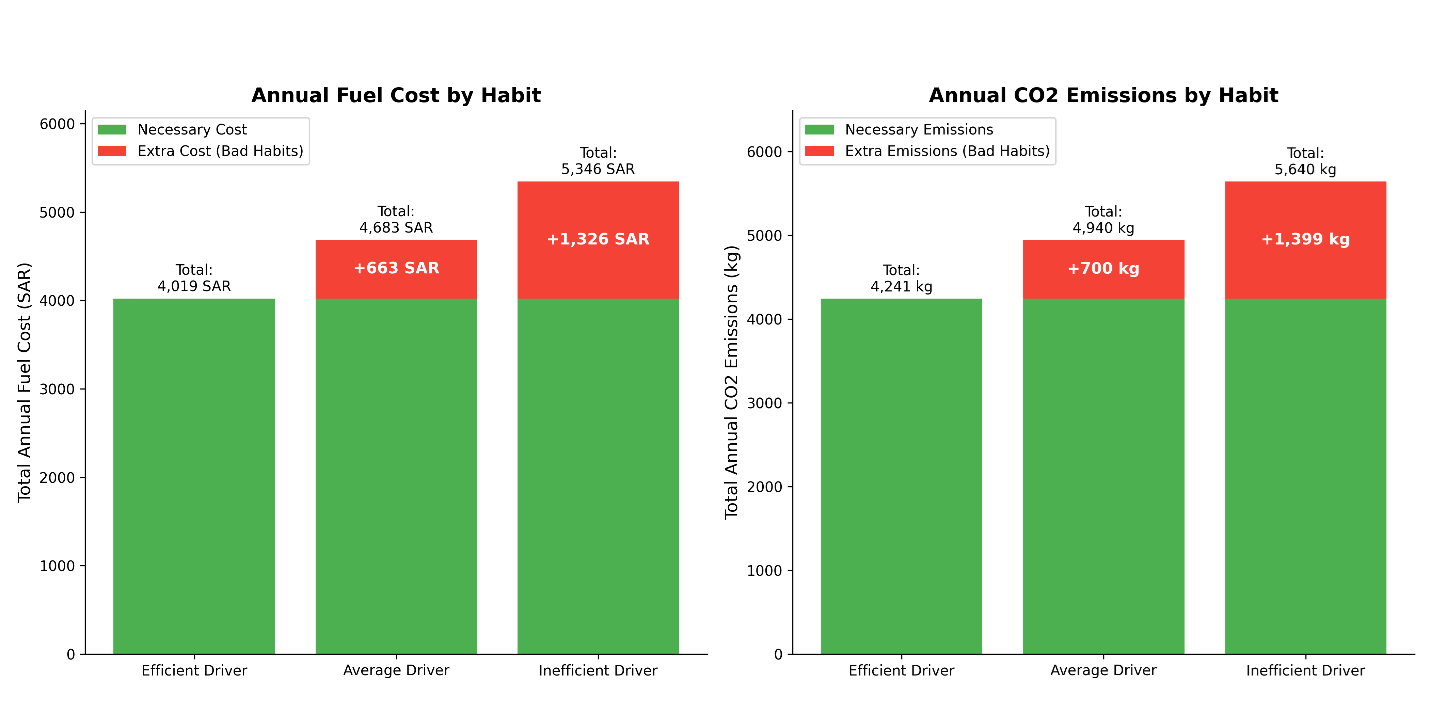 Figure 1: Annual cost and emissions from driving habits (Based on 29,500 km/year in a 2025 CAFE-compliant car)
References
Jung, Heejung S., Michael L. Grady, Tristan Victoroff, and Arthur L. Miller. 2017. "Simultaneously Reducing CO2 and Particulate Exposures via Fractional Recirculation of Vehicle Cabin Air." Atmospheric Environment 160: 77–88. https://doi.org/10.1016/j.atmosenv.2017.04.014.
SASO. 2024. “DRAFT OF SASO 2864:2019: Saudi Arabia Corporate Average Fuel Economy Standard (Saudi Cafe) For Incoming Light Duty Vehicles (2024 - 2028).” https://www.saso.gov.sa/ar/pages/default.aspx.
Thomas, John, Shean Huff, and Brian West. 2014. "Fuel Economy and Emissions Effects of Low Tire Pressure, Open Windows, Roof Top and Hitch-Mounted Cargo, and Trailer." SAE International Journal of Passenger Cars - Mechanical Systems 7 (2): 862–72. https://doi.org/10.4271/2014-01-1614.
[1] https://www.energy.gov/energysaver/driving-more-efficiently
[2] KAPSARC Integrated Transport Energy Demand Model for Saudi Arabia
[3] https://www.energy.gov/eere/vehicles/fact-826-june-23-2014-effect-tire-pressure-fuel-economy
[4] https://www.energy.gov/energysaver/fuel-economy-hot-weather
[5] Natural Resources Canada
Meet the authors